Premier League Managers Performance
 6 min
6 min
The Premier League is defined by big moments, bold decisions and the personalities who shape every campaign from the touchline. Behind each dramatic twist in the season are the Premier League managers whose leadership, strategy and ability to inspire their players turn potential into points. For fans and bettors alike, understanding how these figures perform over time adds an extra layer of insight to every fixture and future prediction.
To get a clearer view of long-term managerial impact, we’ve taken a deep dive into the past decade of data from all current Premier League clubs. Rather than focusing on a single metric, we created a balanced performance index that captures what consistent success really looks like. The model includes win rate, total victories, number of games managed, points per game, and major trophies collected. By combining these indicators, we can evaluate which Premier League managers have delivered the strongest blend of stability, progression and silverware across ten seasons.
The result is a rounded, data-led snapshot of managerial performance, one that celebrates achievement, highlights leadership quality, and offers a useful perspective as you weigh up the season ahead.
The best Premier League manager for their club (in the past 10 years)
Across the past decade, certain Premier League managers have left an undeniable mark on their clubs, combining consistency, tactical clarity and strong results to deliver long-term value.
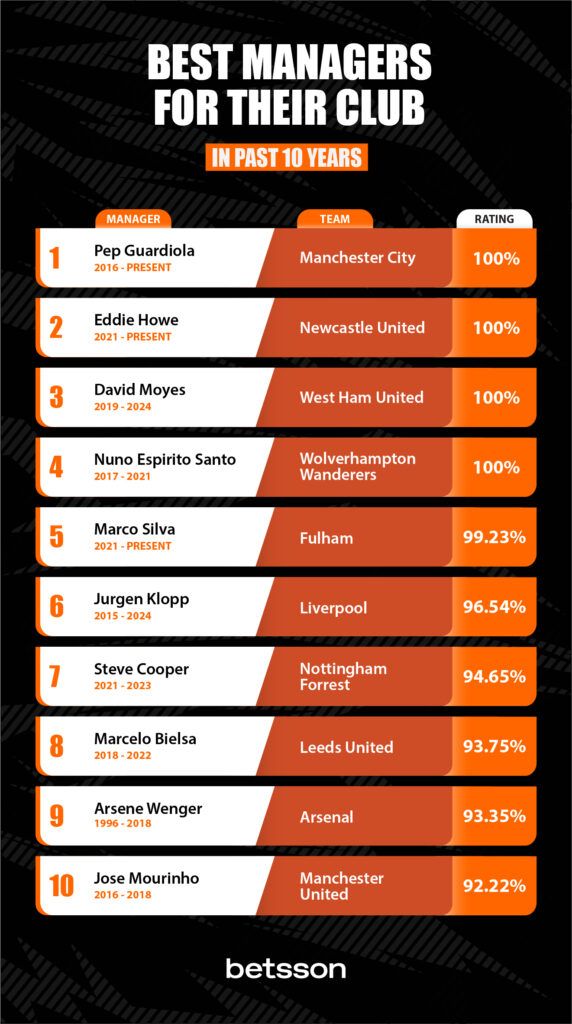
Our index highlights the ten standout leaders who have performed at the highest level for their respective teams, with four managers achieving a perfect score based on having the strongest win rate, victories, games managed, points per game, and trophies won of all their club’s head coaches.
#1: Pep Guardiola (2016 – present)
Guardiola’s time at Manchester City continues to define excellence. His perfect score of 100 reflects sustained success built on control, creativity and an ability to consistently turn strong performances into trophies.
#2: Eddie Howe (2021 – present)
At Newcastle United, Howe has overseen an impressive rise driven by smart coaching, improved structure, and a clear upward trajectory. His 100 rating highlights just how effectively he has reshaped the club’s identity and results.
#3: David Moyes (2019 – 2024)
Moyes’ second spell at West Ham United delivered stability, European success, and a style of football that supporters could truly get behind. His perfect score acknowledges a period of strong development and memorable achievements.
#4: Nuno Espírito Santo (2017 – 2021)
Nuno’s years at Wolverhampton Wanderers brought organisation, confidence and a distinctive style. His 100 rating recognises how effectively he elevated Wolves during a hugely positive chapter for the club.
#5: Marco Silva (2021 – present)
With a score of 99.23, Silva’s influence at Fulham has been transformative. His balanced approach and ability to build cohesion have contributed to one of the league’s most impressive modern rebuilds.
#6: Jürgen Klopp (2015 – 2024)
Klopp’s 96.54 rating reflects a remarkable era at Liverpool marked by energy, passion and trophies. His leadership reshaped the team and delivered some of the most memorable moments of the past decade.
#7: Steve Cooper (2021 – 2023)
Cooper’s time at Nottingham Forest stands out for its calm authority and rapid progress. His 94.65 score highlights his ability to guide the club through pivotal moments with consistency and confidence.
#8: Marcelo Bielsa (2018 – 2022)
Bielsa brought intensity, charisma and a clear identity to Leeds United. His 93.75 rating captures a spell defined by ambition, development and an exciting brand of football.
#9: Arsène Wenger (1996 – 2018)
Wenger’s long tenure at Arsenal may extend beyond ten years ago, but his 93.35 score reflects the strong performances delivered across his reign. His influence remains felt across the modern game.
#10: José Mourinho (2016 – 2018)
Mourinho’s Manchester United years earned him a rating of 92.22, recognising a period where he delivered trophies, structure, and competitive edge. His impact continues to be acknowledged across the Premier League.
The best impact made by a Premier League manager in the past 10 years
When a Premier League manager steps into a club, the immediate impact they make can be just as crucial as long-term success. To understand which leaders have delivered the strongest positive shift from the moment they took over, we analysed how each manager improved their team compared with the previous tenure.

#1: Arsène Wenger (1996 – 2018)
With an impact rating of 93.35%, Wenger sits at the top of this list thanks to the stability, style and strong foundations he left at Arsenal. His lasting influence created a platform that continued to support the club long after his departure.
#2: Daniel Farke (2023 – present)
Farke’s arrival at Leeds United has produced an immediate positive shift, reflected in his impressive 89.49% impact rating. His clarity of approach, organisation and focus on progression have helped rejuvenate the team’s momentum.
#3: Chris Hughton (2014 – 2019)
Hughton’s 87.78% score highlights a highly effective period at Brighton & Hove Albion. His leadership strengthened the squad, improved consistency and laid much of the groundwork for the club’s modern success.
#4: Eddie Howe (2012 – 2015)
During his earlier spell at AFC Bournemouth, Howe made a fantastic contribution, shown by his 85.54% rating. His guidance helped to drive the club forward, establishing confidence and a strong identity.
#5: Antonio Conte (2016 – 2018)
Conte’s time at Chelsea earned him an 84.97% impact rating, reflecting the intensity, structure and winning mentality he brought with him. His tenure delivered success and set high standards for the squads that followed.
The worst impact made by a Premier League manager in the past 10 years
Although some managerial changes don’t deliver an immediate uplift, these periods often represent moments of transition rather than a reflection of a manager’s overall quality or long-term potential.
In our analysis of impact compared with the previous tenure, Graham Potter at Chelsea (2022–2023), Julen Lopetegui at West Ham United (2024–2025) and Ange Postecoglou at Nottingham Forest (2025) recorded the lowest short-term ratings, with scores of –82.97%, –77.53% and –77.50% respectively.
However, it’s important to view these figures in context. Each manager stepped into a unique situation, with differing squad dynamics, expectations and wider circumstances at play. Early challenges can often be part of a broader rebuilding phase or a shift in style that takes time to embed. Many Premier League managers throughout football history have shown that initial difficulties can later give way to stability, progress and strong results.
So, how does our Premier League manager index line up with your own experiences as a Premier League fan? For even more in-depth analysis and commentary, explore our full range of articles over on the Betsson blog.
Methodology
We considered a variety of sources to compile our Premier League manager index, including:
- Soccerbase (https://www.soccerbase.com):All manager history; Number of games managed; Number of wins.
- Transfermarkt (https://www.transfermarkt.co.uk/): Points per game; Number of trophies won.
- Win percentage was created by: Number of wins divided by the number of games, multiplied by 100.
- The Impact Made % is simply the manager’s ‘Index Score’ minus the previous manager’s score
You can find all the best Premier League odds at Betsson!